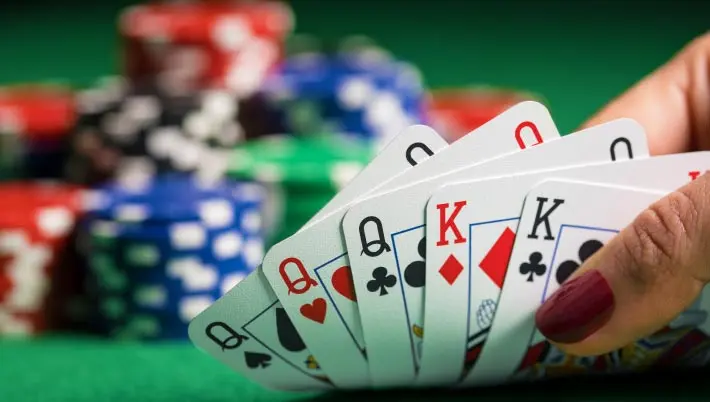
In 1950, John McDonald, a Fortune journalist and best-selling author, published an article in which he expressed his theory that poker is such a popular casino game because it's a microcosm of the struggles and successes of our real lives. The theory continues to intrigue casino observers and game developers feel that understanding what drives people to play will facilitate their efforts to ensure that the game remains as appealing as possible to the gaming public.
Players should also be aware of their reasons for playing poker. Do you play because it stimulates you intellectually? Because you enjoy the social aspects of the game? Because, with wins and losses that can occur in a matter of seconds, it keeps you on your toes? Regardless of whether you play in neighborhood pick-up games, in tournaments at brick-and-mortar casinos or at the Vegas online casino, it's to your benefit to understand what draws you and millions of other poker enthusiasts to choose poker when you gamble.
Poker
Some historians say that poker originated as a the As Nas Persian card game that dates back to the 16th century. Others claim that it can be traced to a domino-card game that was popular in the royal court of a 10th-century Chinese emperor.
The poker that we know today, however, is quite different from either of these early games. Modern poker was introduced to European casinos in the 17th and 18th centuries and has continued to evolve – today, poker aficionados have their choice of up to a dozen poker variations.
All of these variations have one thing in common – all poker variations involve a combination of skill and luck which reduces the element of chance and gives skilled players the chance to compete on a higher level.
Additionally, many observers believe that the game of poker reflects the values of our culture – specifically the drive to succeed.
The theory was first introduced by John McDonald, a staff writer for Fortune Magazine in 1950. McDonald specialized in writing about business and the economy. In a series of articles about games of the post-WWII era, he started to examine how poker mimics American capitalism.
His articles evolved into a book, Strategy in Poker, Business & War in which he expanded on the idea of how poker differs from other gambling games. He posited that the combination of luck plus skill is different than other games because "the spirit of poker” (bluffing) is vital for creating "uncertainty between the players."
Success, therefore, is dependent on the gamer's "shrewdness, cunning, deception, conscious strategies, suspicious appraisals of worth and character, and bold aggressions." In short, said McDonald, poker must be played in a way that ensures that "all of the repressed values of a competitive society are let loose and placed first in the order of proprieties."
Poker, Politics and Business
According to McDonald, poker can be used to study game theory, a model that is based on the work of Oskar Morgenstern and John Von Neumann, that theorizes that poker is more than a recreational activity that satisfies the intellectually inclined but is applicable to real life as well. The research shows how poker and other strategic areas of life – business, politics, war, etc – are related.
For McDonald, poker is a laboratory of capitalism and socialism. In poker, it's possible to see how optimal decision-making plays out. It can help to explain real-world scenarios, including conflicts and the economy. Poker, said McDonald, is the best model because it involves every possible element of life – choice, chance, imperfect information and interdependence.
Some of the poker variations where the intersection between poker and real life can be best seen include:
Caribbean Draw Poker
When you play Caribbean Draw Poker, you experience the structure of a traditional 5-card draw poker game along with elements of a house-banked game. To win, you'll need to beat the dealer's hand. The game opens with a deal with 5 face-up cards, both to the dealer and to the player. One of the dealer’s cards is exposed. During the initial draw phase, you can raise or fold. If you raise, you make a second deposit that totals double the ante. After the bet, you can trade in up to 2 cards.
Many poker enthusiasts like Caribbean Draw poker because the gameplay is simple and there’s a high chance that you'll receive a large payout. Many variations of Caribbean Draw Poker (including the version featured at Grande Vegas) offer the chance to compete for the progressive jackpot prize. It's a relaxing game for casual players since there are no betting rounds. If you're looking for a game with a high Return to Player, Caribbean Draw Poker isn't advised since there's a high House Edge.
Jacks or Better Poker
Jacks or Better poker is a straightforward poker variation. You'll need a pair of Jacks or better to win but other than that, the rules are similar to those of a traditional game of 5-card draw poker. At the opening of the game, you'll receive 5 cards. You can hold or trade some or all of your cards. After the trade, if your hand's value exceeds that of the dealer, you'll receive a payout based on the amount of your bet and the hand’s rank.
Jacks or Better has one of the lowest house edges in the casino. If you know the rules of 5 Card Draw Poker, you'll be ready to play.
Aces and Eights Poker
Aces and Eights Poker follows the standard 5-card draw goal of building the strongest hand. However, in the Aces or Eights Poker variation, special payouts are paid out if your hand includes either a pair of aces or a pair of eights. In this game, you receive seven cards (some face-up and some face-down) and build your poker hand with 5 of those cards.
Many players prefer Aces and Eights Poker because the Return to Player percentage is one of the highest at the casino – 99% which makes it a favored game among players in the know.
Poker forces you to play the hand that you’re dealt - as they say - just like in real life.